To find a quality transmission auto repair shop in Honolulu, look for ASE-certified technicians (specifically holding A2 Automatic or A3 Manual certifications), advanced diagnostic equipment worth $5,000 or more, nationwide warranty coverage of at least 12 months or 12,000 miles, and deep roots in the local community.
At Pearl City Auto Works, we have provided Oahu drivers with honest auto repairs since 1987. As a family-owned NAPA AutoCare Center backed by experienced mechanics, we offer clear answers and transparent estimates to keep your vehicle operating safely in Hawaii's demanding island environment.
Transmission problems rarely announce themselves politely. One day your vehicle shifts smoothly down the H-1 highway; the next, you encounter delayed engagement at an Aiea stoplight or notice reddish fluid pooling on your driveway.
Driving on Oahu presents challenges that mainland vehicles never encounter. Stop-and-go commuter congestion, steep mountain climbs up H-3 or Pali Highway, and continuous exposure to salt air accelerate vehicle wear by roughly 40%. Understanding how to evaluate a trustworthy auto repair shop can save you thousands of dollars in unnecessary engine and drivetrain repairs.
What Separates Quality Transmission Shops From the Rest
Not every neighborhood service station possesses the specialized equipment or training necessary to service modern transaxles. When evaluating repair centers across Honolulu, we suggest verifying several key qualifications before handing over your keys.
1. Specialized ASE Certifications
National Institute for Automotive Service Excellence (ASE) certifications ensure technicians pass rigorous testing and maintain two full years of hands-on experience. For complex drivetrain work, look for technicians holding A2 Automatic Transmission/Transaxle or A3 Manual Drive Train and Axles designations. Industry data confirms that shops employing certified specialists record 34% fewer repeat repair issues.
2. Comprehensive Nationwide Warranty Coverage
A repair shop's warranty indicates how strongly they stand behind their diagnostic accuracy and replacement parts. Basic repair facilities often provide 90-day or 3,000-mile warranties. Quality auto care facilities offer minimum protections of 12 months or 12,000 miles. Facilities confident enough to offer long-term warranties consistently maintain claim rates under 5%, compared to the 8% to 12% industry average.
3. OEM-Level Diagnostic Equipment
Modern transmissions contain complex networks of internal solenoids, fluid pressure sensors, and dedicated control modules. Diagnostic scanners designed for transmission evaluation cost between $5,000 and $15,000, whereas basic code readers cost under $500. Handheld code readers frequently miss subtle pressure variations, leading to incorrect diagnoses in nearly 30% of cases. Professional equipment allows technicians to monitor live sensor feeds directly during road tests.
| Qualification Standard | Generic Repair Shops | Pearl City Auto Works |
|---|
| Technician Credentials | General Mechanics | ASE-Certified Technicians |
| Diagnostic Scanners | Basic OBD-II Scanners ($100 to $500) | OEM-Grade Transmission Diagnostic Systems |
| Warranty Protection | 90 Days / 3,000 Miles | 12-Month / 12,000-Mile Nationwide Warranty |
| Local Service Record | Varies | Family-Owned Serving Oahu Since 1987 |
| Parts Selection | Generic Aftermarket / Used | High-Grade NAPA & OEM Components |
Warning Signs Your Transmission Needs Immediate Attention
Recognizing subtle warning signals early lets you fix minor component faults before they cause complete transmission failure.
Fluid Leaks and Fluid Oxidation
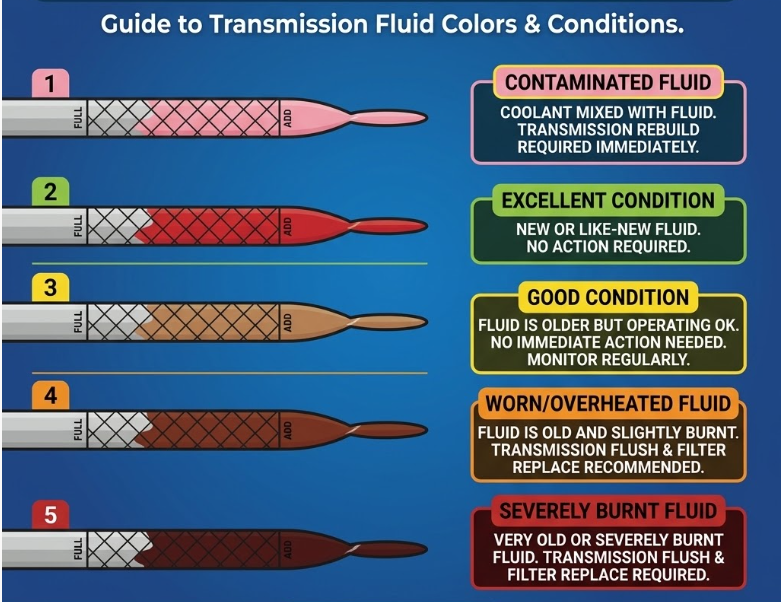
Automatic transmission fluid (ATF) cools internal components, lubricates bearings, and transfers hydraulic power to engage gear sets. Checking fluid health gives clear insight into internal component wear:
- Bright Red and Clear: Healthy fluid operating within normal temperature ranges.
- Dark Brown: Oxidized fluid damaged by excessive operating heat.
- Black with Burnt Odor: Severe overheating where internal clutch friction plates are actively decomposing.
- Milky Light Pink: Fluid contaminated by engine coolant from a damaged radiator heat exchanger.
Hawaii's tropical climate elevates fluid temperatures 30°F to 50°F higher than flat mainland highway driving. Fixing a small shaft seal leak early generally costs between $150 and $400. Operating a vehicle with depleted fluid leads to gear seizure, requiring a full assembly replacement costing $3,500 to $8,000.
Irregular Shifting Patterns
- Delayed Engagement: A temporary hesitation between moving the gear lever into Drive or Reverse and feeling the transmission engage.
- Slipping Gears: Engine RPMs increase suddenly without a matching gain in vehicle speed.
- Rough Gear Transitions: Hard clunking sounds or physical jolts during automatic gear changes.
Nearly 73% of major transmission breakdowns exhibit these symptoms one to six months prior to complete operational failure. Addressing early warnings reduces total repair expenses significantly.
What Happens During Your Transmission Repair
We design auto repair services to minimize inconvenience for Oahu drivers:
- Initial Service Consultation: We discuss observed symptoms, review service histories, and record driving conditions.
- Comprehensive Inspection: Mechanics run digital scanner checks and physical inspections to isolate internal issues.
- Transparent Review: We share diagnostic findings and outline pricing options before performing any repair work.
- Precision Service: ASE-certified technicians perform repairs using high-grade components.
- Quality Verification Road Test: We test drive your vehicle under island commuting conditions to verify smooth shifting and stable operating temperatures.
- Vehicle Hand-off & Warranty Protection: You collect your vehicle alongside clear warranty documentation detailing your coverage.
To help you maintain your daily routine during multi-day repairs, ask our team about available loaner vehicle arrangements.
Making Your Transmission Last
Consistent preventive maintenance extends an automatic transmission's operating lifetime past 200,000 miles, ensuring reliable performance across Oahu. Conversely, neglected transaxles frequently experience major internal failure between 80,000 and 120,000 miles, leading to costly unexpected overhauls.
Essential Vehicle Maintenance Habits:
- Change Fluid Every 30,000 Miles: Hawaii driving qualifies as severe duty service due to ambient heat, humidity, and constant acceleration cycles. Fresh fluid prevents thermal breakdown.
- Use Parking Brakes on Steep Incline Parking: Engage your mechanical parking brake before putting the vehicle into Park on steep hills to prevent excess pressure on the parking pawl.
- Shift into Neutral During Long Traffic Delays: Sitting stationary in heavy traffic on hot days while holding the brake pedal elevates fluid heat inside the torque converter. Shifting into Neutral helps lower operating temperatures.
- Inspect External Fluid Lines Periodically: Salt air accelerates metal corrosion along external transmission cooler lines. Check under your vehicle regularly for damp spots or rust accumulation.
What Local Oahu Drivers Are Saying
We take pride in offering reliable service to our community. Local vehicle owners share their experiences with Pearl City Auto Works below:
"Gotta love Pearl City Auto Works, very friendly, helpful, trustworthy, and reliable. They've done some work on my van some time ago and now doing my Tacoma truck recently and gave me the best service ever... what I love is they also call you keeping you informed and up to date letting you know the progress. I will continue to support this local family business for all my automotive needs!"
Zach H., Local Customer
"Honest mechanics that try to find the best deal on parts, not just go straight to the dealer. I had a vehicle I took to three other shops and no one knew what was wrong. I thought it was going to cost me over a thousand dollars, but they figured it out and it was just a hundred... I only recommend this place."
Jacob W., Local Customer
Frequently Asked Questions (FAQ)
1. How often should I get my transmission fluid changed in Hawaii?
Because Oahu driving involves heavy commuter traffic, warm temperatures, and steep mountain terrain, we recommend changing automatic transmission fluid every 30,000 miles. Following this schedule protects internal clutches from heat degradation.
2. Can I continue driving if the check engine light or transmission warning light turns on?
If the dashboard light remains solid and your vehicle shifts normally, schedule a diagnostic inspection promptly. If the warning light flashes or your vehicle slips out of gear, pull over safely and contact a towing service to avoid severe mechanical damage.
3. What is the difference between a fluid flush and a fluid drain-and-fill service?
A drain-and-fill service drains fluid from the oil pan, replacing roughly 40% to 60% of total system fluid alongside a new filter. A fluid flush utilizes fluid exchange equipment to clear fluid across the transmission case, cooler lines, and torque converter. Our mechanics inspect your vehicle's mileage to recommend the safest option.
4. What warranty coverage comes with transmission repairs at Pearl City Auto Works?
As a certified NAPA AutoCare Center, our major transmission services and repairs are backed by a 12-Month / 12,000-Mile nationwide warranty. This covers both parts and labor, giving you total peace of mind whether you're commuting across Oahu or driving on the mainland.
5. How long does a typical transmission service take?
Routine fluid maintenance and sensor replacements take 1 to 2 business days. Comprehensive assembly rebuilds or remanufactured unit swaps generally take 3 to 5 business days to complete installation, fluid flushing, and road testing.
Get Expert Transmission Service in Aiea & Honolulu
Avoid letting transmission issues disrupt your daily commute. Contact Pearl City Auto Works to schedule a thorough diagnostic evaluation and review clear repair options with our team.
BOOK A NO-CONTACT APPOINTMENT