Merging onto the H-1 freeway should be a smooth transition. You accelerate up to highway speed, only to feel a rhythmic vibration take over your steering wheel. As you hit 60 MPH, the vibration turns into a violent shake. Your hands feel numb, and the entire cabin of the vehicle feels unstable.
Many drivers on Oahu experience this exact scenario and mistakenly assume it is just a quirk of driving an older car or dealing with rough island roads. A shaking steering wheel is never normal. It is a distinct mechanical cry for help. The extreme rotational forces generated at 60 MPH magnify tiny imbalances and loose components that remain hidden at lower speeds. Ignoring this vibration accelerates the wear on expensive steering components and drastically increases your risk of a high-speed tire blowout.
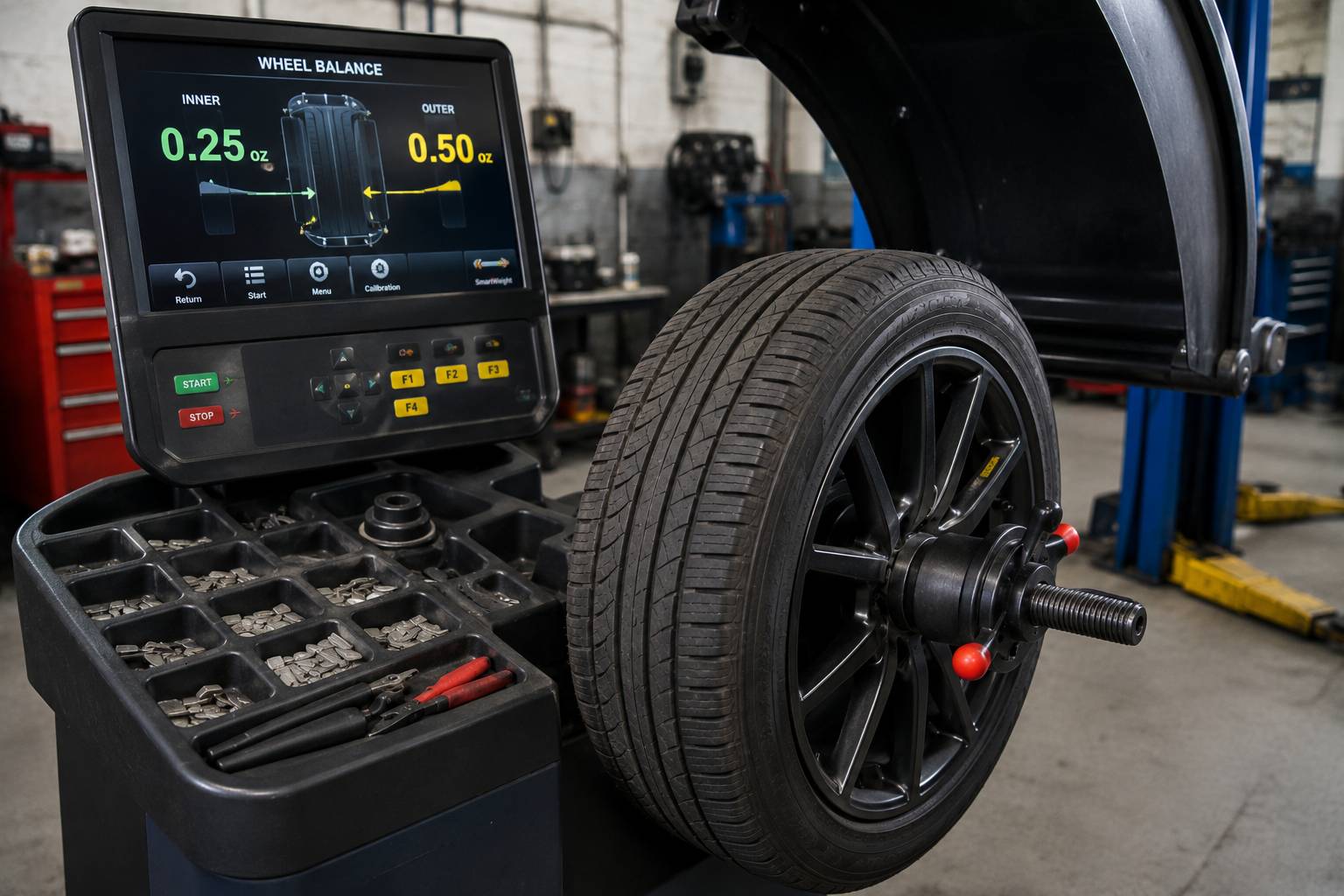
Computerized wheel balancing machines detect microscopic weight imbalances in the tire assembly
The Difference Between Tire Balance and Wheel Alignment
When a car shakes at highway speeds, drivers usually jump to the conclusion that they need a wheel alignment. While an alignment is crucial for vehicle health, a vibration is more frequently caused by a balance issue. Understanding the difference between these two services is the first step in diagnosing the problem.
Tire Balancing
A tire and wheel assembly is a heavy mass of rubber and metal. Even brand new from the factory, a tire is never perfectly uniform in weight. A tire balancing machine spins the wheel assembly at high speeds to detect exactly where the heavy spots are located. The mechanic then attaches small lead or zinc weights to the opposite side of the rim to counter the heavy spot.
If a weight falls off, or if you hit a deep pothole on Kamehameha Highway that slightly bends the rim, the assembly becomes unbalanced. This imbalance creates a hopping motion as the wheel spins. You typically will not feel this hop at 30 MPH. However, as you reach 55 to 65 MPH, the frequency of the hop resonates through the steering column and creates a violent shake in your hands.
Wheel Alignment
Wheel alignment does not involve adding weights. It is the precise adjustment of the vehicle's suspension geometry. Factory engineers dictate the exact mathematical angles at which the tires should meet the road (known as camber, caster, and toe).
Hitting a curb or a pothole knocks these delicate angles out of specification. A misaligned vehicle typically causes the car to pull sharply to the left or right when driving straight. It does not normally cause a vibration on its own. However, severe misalignment causes the tire tread to wear down unevenly in a "cupping" or "scalloped" pattern. This heavily deformed rubber will cause the car to shake at high speeds.
Worn Suspension Components: The Hidden Culprits
If your tires are perfectly balanced and the alignment is straight, a high-speed shake points directly to failing suspension components. Your suspension system uses a network of metal arms and rubber joints to absorb road impacts and keep the tires firmly planted on the pavement.
Control Arms and Bushings
The control arm acts as the hinge that connects the wheel hub to the main frame of the car. It utilizes thick rubber bushings to isolate the metal components and absorb vibration. The intense heat of the Hawaii climate degrades this rubber rapidly. When the bushing cracks and falls apart, the metal control arm is left to bang around loosely inside its mounting bracket. This excessive play translates into a severe shudder at highway speeds and a loud clunking noise over speed bumps.
Failing Ball Joints
Ball joints act exactly like the ball-and-socket joints in your shoulders. They allow the front wheels to pivot left and right for steering, while simultaneously moving up and down over bumps. The internal bearings of a ball joint crush over time from the constant impact of rough roads. A loose ball joint allows the entire wheel to physically wobble on its axis at 60 MPH. If a ball joint snaps completely while driving, the wheel will collapse inward, resulting in an immediate loss of control.
Worn Tie Rod Ends
The tie rods connect your steering rack directly to the wheel hubs. Every time you turn the steering wheel, the tie rods push or pull the tires in the desired direction. When the joints at the end of the tie rods wear out, they introduce "slop" into the steering system. The tires are no longer held rigidly straight. As the wind resistance builds at 60 MPH, the loose tie rods allow the front tires to rapidly flutter left and right, violently shaking the steering wheel.
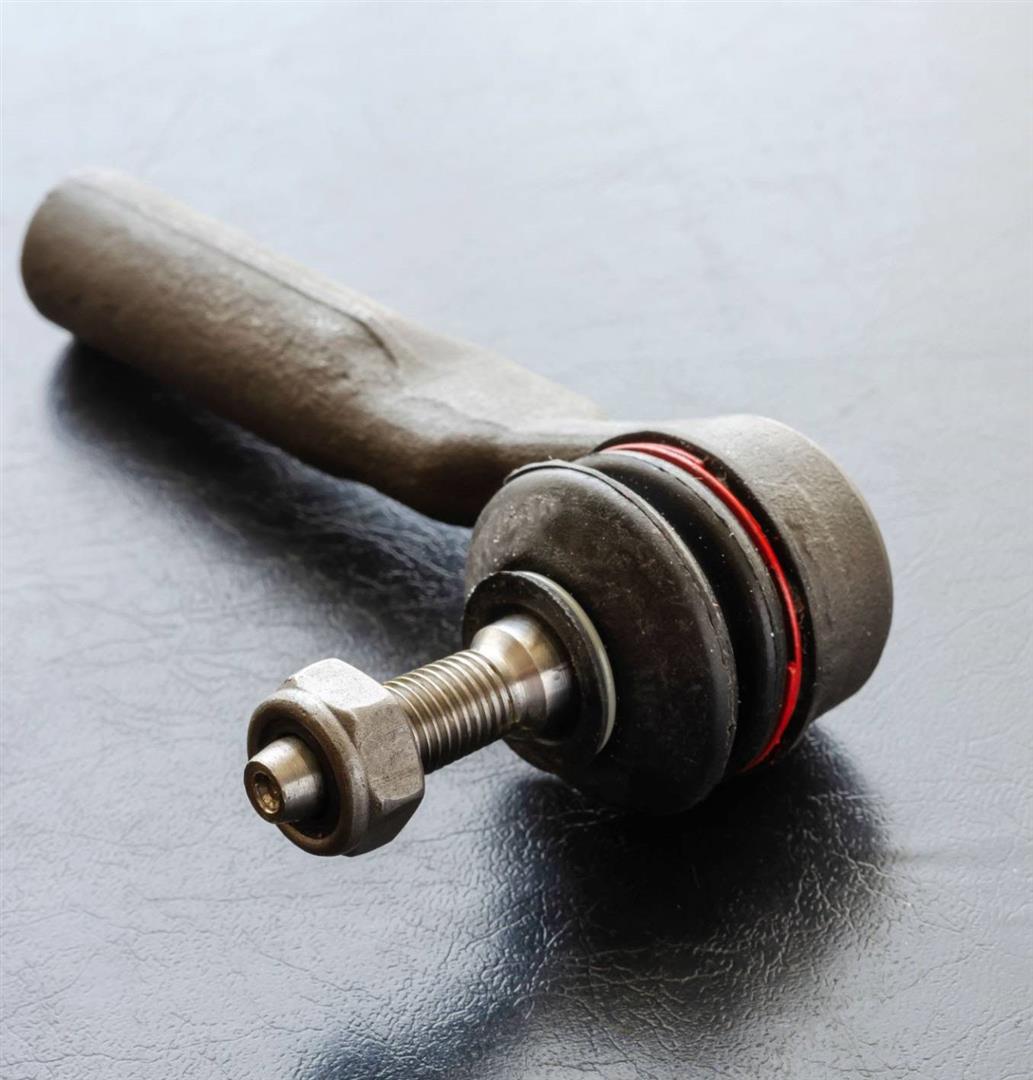
Worn tie rod ends introduce dangerous slack into your steering system
Diagnosing the Shake by Location and Timing
Paying attention to when and where you feel the vibration provides crucial clues for your mechanic.
| Vibration Characteristic | Where You Feel It | Most Likely Mechanical Cause |
|---|
| Shakes only between 55-65 MPH | Steering Wheel | Out-of-balance front tires or bent front rim. |
| Shakes only between 55-65 MPH | The driver seat / floorboard | Out-of-balance rear tires or bent rear rim. |
| Shakes only when applying the brakes | Steering wheel and brake pedal | Warped front brake rotors from heat distortion. |
| Wanders and shakes at all speeds | Steering Wheel | Severely worn tie rod ends or ball joints. |
| Vehicle pulls sharply to one side | Steering Wheel (must hold tightly) | Requires an immediate wheel alignment. |
Frequently Asked Questions About Car Vibrations
Is it safe to drive if my car shakes at 60 mph? No. A high-speed vibration is extremely dangerous. It severely compromises your steering control and rapidly fatigues metal suspension components. If the shake is caused by a failing ball joint or a severely damaged tire, continuing to drive at highway speeds risks a catastrophic blowout or suspension collapse.
Does an alignment fix a vibrating steering wheel? An alignment generally fixes a vehicle that pulls to one side or suffers from rapid, uneven tire wear. If the vibration is caused by "cupped" tires resulting from poor alignment, fixing the angles will help prevent future wear, but the tires themselves may still need to be replaced or rebalanced to stop the shaking completely.
Can hitting a single pothole cause my car to shake? Absolutely. Hitting a deep pothole transfers a massive amount of kinetic energy into the wheel assembly. This impact easily bends aluminum rims, knocks off wheel balancing weights, and bends steel tie rods. Any of these three issues will immediately result in a high-speed vibration.
Why does the shaking stop when I go faster than 70 mph? This relates to the resonant frequency of the unbalanced mass on the tire. An out-of-balance wheel creates a frequency that matches the natural frequency of the vehicle's suspension right around 60 MPH. Pushing past 70 MPH changes the frequency of the spinning tire, taking it out of phase with the suspension. The imbalance is still there and still causing damage, even if you can no longer feel it in the steering wheel.
How do I know if my shaking is from the engine or the tires? If the vibration only occurs when the vehicle is physically moving at a specific speed, the issue is related to the wheels, tires, or suspension. If the vehicle shakes while you are parked with the engine running, or the check engine light is flashing, you are experiencing an engine misfire that requires entirely different diagnostics.
What Local Oahu Drivers Are Saying
"I really loved their honest look at a pre-purchase inspection. We were in need of a car and they got us in quickly to look at the car. We will definitely be back."
- Beki Marshall, Local Customer
"I give Pearl City Auto Works a 5 Star rating because our experience with them has been welcoming and efficient from the quotation of repairs, time to take care of the repairs and follow through. I will be coming back for servicing all of our family cars/SUVs. We need more local companies looking out for their customer's welfare."
- Elliot Chang, Local Customer
Professional Suspension and Alignment Services in Pearl City
Tolerating a shaking steering wheel ruins the driving experience and puts you in unnecessary danger on the H-1 freeway. According to the National Highway Traffic Safety Administration (NHTSA), properly maintained tires and suspension systems are critical for avoiding high-speed collisions and maintaining evasive steering capabilities.
If your vehicle exhibits any high-speed vibrations, trust the ASE-certified technicians at Pearl City Auto Works to locate the source accurately. We utilize state-of-the-art computerized wheel balancers and laser alignment racks to restore your vehicle to factory specifications. If a component is worn, our comprehensive digital inspections provide photographic proof so you understand exactly what needs replacing. Do not let a minor tire imbalance turn into a major suspension failure.
Book a no contact appointment