
Picture this: You are sitting in bumper-to-bumper traffic on the H-1 freeway, stuck near the airport exit at 3:00 PM. The afternoon sun is blazing down, and suddenly, your car’s air vents start blowing warm, sticky air. You turn the dial down to max cold, but nothing changes. Within minutes, your cabin feels like a sauna.
With heat index values hitting 90 to 105°F for roughly 180 days a year across Oahu, a broken auto air conditioner isn't just a minor inconvenience: it is a genuine health and safety concern. Driving in extreme cabin temperatures causes fatigue, slows your reaction times, and makes daily commutes miserable.
At Pearl City Auto Works, we have been keeping Oahu drivers cool and comfortable since 1987. As a second-generation family-owned, NAPA AutoCare Center, our ASE-certified team brings over 100 combined years of hands-on mechanical experience to every vehicle we service. In this comprehensive guide, we will walk you through how your vehicle's air conditioning system works, how to spot warning signs, what local repairs actually cost in Hawaii, and how to get your cool air back fast.
What AC Repair Costs in Honolulu
Auto repair costs in Hawaii run approximately 18% to 25% higher than mainland averages. This price difference stems from trans-Pacific shipping fees on replacement parts, higher local utility rates, and specialized labor rates on Oahu, which average $110 to $145 per hour locally versus $85 to $110 per hour nationally.
Understanding local pricing helps you plan for necessary service:
| Service / Repair Type | Typical Cost Range (Hawaii) | Key Factors Included |
|---|
| System Diagnostic & Leak Test | $95 to $185 | Visual check, pressure test, UV dye injection, electronic leak detection |
| AC Recharge (R-134a System) | $150 to $250 | Evacuation, vacuum decay test, up to 2 lbs refrigerant, performance test |
| AC Recharge (R-1234yf System) | $250 to $400+ | Specialized recovery, precise weight filling, new refrigerant charge |
| AC Hose / Line Replacement | $200 to $450 | Hose assembly, line seals, evacuation, and system recharge |
| AC Compressor Replacement | $800 to $1,500 | New compressor, clutch assembly, flush, oil balance, and recharge |
| Evaporator Core Replacement | $1,200 to $2,200 | Complete dashboard removal labor, core replacement, seals, and recharge |
Source: Local shop rate surveys
Every professional AC repair at Pearl City Auto Works includes complete system evacuation to pull out moisture, vacuum testing to confirm sealing integrity, and exact refrigerant measuring. Best of all, our work is backed by our nationwide 12-Month / 12,000-Mile Warranty.
How Your Car's AC System Removes Heat
Many drivers assume their car’s AC blows cold air into the cabin. In reality, it removes heat from the cabin. Your vehicle relies on a closed-loop refrigeration cycle driven by four primary components:
The Compressor:
Driven by your engine's serpentine belt, the compressor squeezes low-pressure refrigerant gas into a high-pressure, high-temperature gas.
The Condenser:
Located right behind your front grille, the condenser radiates heat away from the hot refrigerant gas, converting it back into a high-pressure liquid.
The Expansion Valve / Orifice Tube:
This component acts as a bottleneck. As high-pressure liquid flows through a tiny orifice, the pressure drops rapidly, creating a freezing-cold low-pressure liquid state.
The Evaporator:
Tucked deep behind your dashboard, cold liquid refrigerant passes through the evaporator core. Your blower fan pushes warm cabin air across these freezing fins. The refrigerant absorbs the heat and moisture, blowing refreshed, chilled air directly through your dash vents.
5 Signs Your AC Needs Repair Now
Recognizing early warning signs prevents a minor fix from escalating into a full system failure. If you notice any of these five red flags, your AC system needs immediate attention:
- Weak Airflow from the Vents: If the air is ice-cold but barely blowing, you are likely dealing with a failing blower motor, a clogged cabin air filter, or an evaporator core choked with debris.
- Air Blows Warm or Lukewarm: Strong airflow with no cold temperature points directly to low refrigerant levels, a blown compressor clutch fuse, or an electrical pressure switch issue.
- Intermittent Cooling: If your AC blows ice-cold for 10 minutes and then turns warm, the system may be freezing up due to excess moisture, or the compressor clutch gap has worn down.
- Unusual Noises Under the Hood: A sharp squeal upon turning on the AC points to a slipping serpentine belt, while grinding or clacking noises under the hood signal internal compressor bearing failure.
- Musty Odors or Wet Passenger Carpets: A damp smell indicates mold or bacteria growth inside the dark, humid evaporator housing. If you find standing water on the passenger side floorboard, your evaporator drain tube is clogged.
Hawaii Coastal Fact: Due to Oahu's tropical climate, microbial and mold growth inside vehicle evaporators develops nearly three times faster in Hawaii than in dry, inland states like Arizona or Nevada.
Why Your AC Isn't Blowing Cold Air
While a lack of chilled air is always frustrating, the underlying root cause usually falls into one of four distinct technical categories:
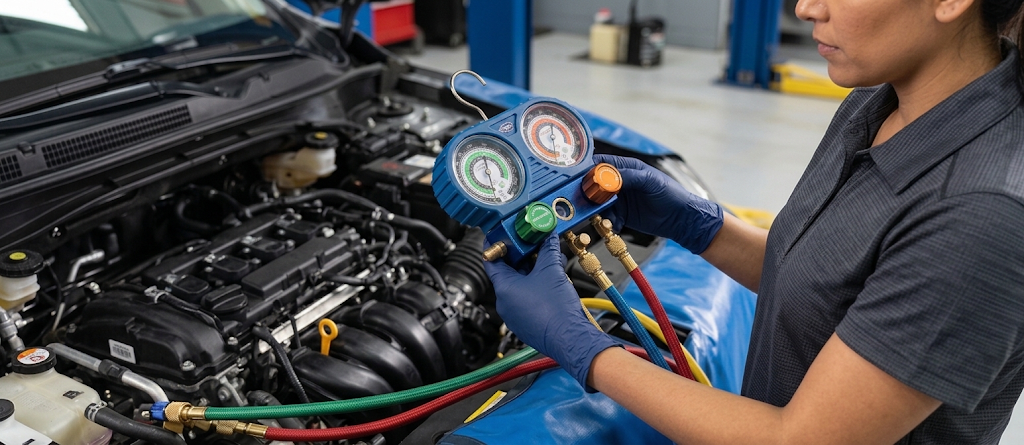
ASE-certified technicians inspect compressor components for wear and leaks.
1. Refrigerant Leaks & Salt Air Corrosion
Refrigerant operates in a sealed system; it does not consume or "burn off" like engine oil. If your refrigerant is low, you have a leak.
Here in Hawaii, environmental conditions accelerate component decay:
- Condenser Corrosion: Ocean salt air eats away at thin aluminum cooling fins. Salt air corrosion accounts for nearly 35% of all AC failures on Oahu.
- Hose and O-Ring Deterioration: Rubber hoses and rubber seals degrade 40% to 60% faster in coastal tropical environments compared to dry climates.
2. Compressor Clutch and Internal Mechanical Failure
The compressor is the heart of your AC system. Running your AC with low refrigerant starves the compressor of the lubricating oil mixed into the gas, leading to severe friction damage.
3. Electrical and Sensor Interruptions
Modern vehicle climate systems rely on dual pressure switches, cabin temperature sensors, ambient air sensors, and electronic relays. A single corroded wire or blown relay prevents the compressor clutch from engaging.
4. Clogged Expansion Valves or Evaporators
Debris or metal shavings from a wearing compressor can clog the orifice tube or expansion valve, blocking refrigerant flow completely.
Should You Fix Your AC or Replace the Car?
When faced with a repair quote over $1,000, many vehicle owners wonder if it makes sense to fix the car or put that money toward a replacement vehicle.
National automotive guidelines usually recommend fixing a vehicle if the total repair bill is under 15% of the car's current market value. However, living on Oahu alters this financial math:
- Resale Impact in Hawaii: A broken air conditioner reduces a vehicle's resale value by 8% to 15% in the local market. In fact, working AC is listed as a critical requirement in 89% of Hawaii used car searches, compared to just 62% nationally.
- Fuel Efficiency Myths: Driving on the freeway with your windows down creates severe aerodynamic drag, increasing fuel consumption by 20% to 25%. In contrast, running a healthy AC system on the highway only impacts fuel efficiency by roughly 10% to 15%.
As a trusted, family-owned business, our policy is simple: we provide clear, honest recommendations. We will tell you straightforwardly if repairing your AC makes financial sense or if you are better off keeping your money.
What Local Oahu Drivers Are Saying
Local vehicle owners frequently share their experiences with our Pearl City auto repair team:
"Pearl City Auto Works saved my daily commute! The AC in my Honda Civic died right at the start of summer. They diagnosed a salt-corroded condenser, gave me a straightforward quote, and had it blowing ice-cold air the same day. Honesty and fast turnarounds are hard to find, so these guys are the best on island."
Brandon M., Local Customer
"I've been taking my vehicles to Pearl City Auto Works for years. Their team is transparent, professional, and never pushes unnecessary work. They fixed an ongoing electrical AC glitch that two other shops couldn't figure out. Mahalo to the whole team!"
Leilani K., Local Customer
Frequently Asked Questions
1. How long should an AC recharge last?
In a completely sealed system, refrigerant should last for the entire operational lifetime of your vehicle. It is not something that naturally depletes. If your system requires topping off every year, you have an active refrigerant leak that needs to be diagnosed and sealed.
2.. Why does my car AC smell like wet socks or mildew when I turn it on?
Musty smells originate from mold, fungus, and mildew growing on the dark, damp surface of your evaporator core inside the dashboard. To fix this, we clear blocked evaporator drain lines and perform a specialized professional sanitizing treatment on the HVAC intake system.
3. How long does a professional AC diagnostic take at Pearl City Auto Works?
A standard, thorough AC diagnostic takes 45 to 90 minutes. During this window, our ASE-certified mechanics inspect components, run dual-side pressure checks, perform UV leak detection, and test electronic controls to ensure we identify the exact root cause the first time.
Schedule Your AC Repair Today
Don't sweat through another hot commute on the H-1 or Kamehameha Highway.
Get same-day diagnostics and expert auto air conditioner repair from Oahu's trusted automotive specialists!
Book a No-Contact Appointment